Case Study / AI Customer Support Platform
AI Customer Support Platform
Built a multimodal AI support platform that classifies customer requests, routes conversations, prevents duplicate cases, and keeps human operators in control through deterministic workflow orchestration.




The Problem
Customer requests come in formats like text, audio, images, and documents, causing standard automation to break down.
Every enquiry required manual review before an agent could respond. Low-quality leads consumed valuable time, high-quality opportunities were delayed, and inconsistent decision making reduced sales efficiency.
Operational Challenge
- Customer enquiries arrived through multiple channels.
- Duplicate tickets increased manual workload.
- Operators spent time classifying repetitive requests.
- Follow-ups were inconsistent across cases.
System Objectives
- Build a single intake pipeline capable of handling inputs of all types ( Texts, Audio, Images, Docs, etc...)
- Ensure AI performs request understanding while deterministic workflow logic governs every business action.
- Prevent duplicate tickets and invalid submission before they reach downstream systems.
- Keep human operators in control by routing low-confidence or high-priority cases for review before execution.
Architecture
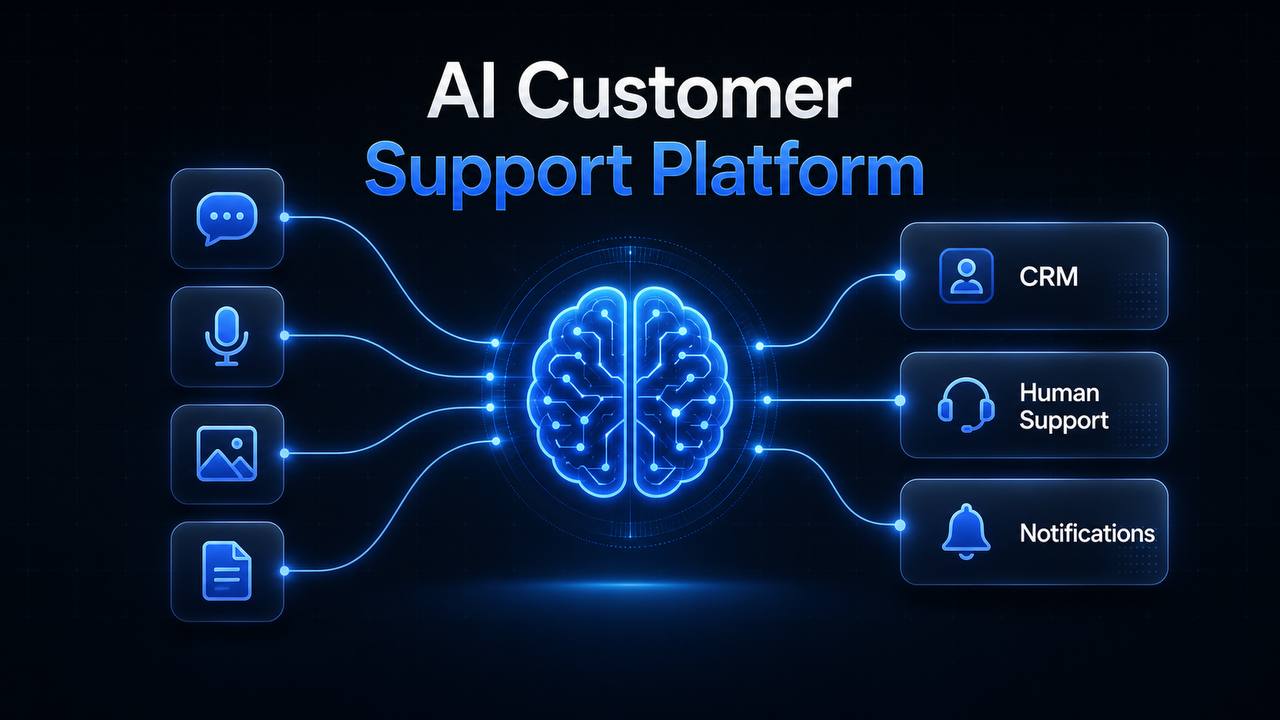
System architecture designed for reliable AI-assisted customer support.
The platform separates AI reasoning from workflow execution, allowing customer requests to be classified intelligently while deterministic automation governs routing, validation, notifications, and CRM integration.
Multimodal Intake
The platform accepts text, voice notes, images, and documents through a unified entry point, normalizing every request before AI processing begins.
Deterministic Validation
AI extracts intent and structured data, while workflow logic validates inputs, blocks duplicate requests, and enforces business rules before execution.
Intelligent Routing
Validated requests are automatically classified, prioritised, and routed to the correct CRM pipeline, support queue, or notification workflow.
Human-in-the-Loop
Low-confidence predictions and high-priority cases are escalated for manual review, ensuring automation remains transparent, reliable, and accountable.
CRM Routing
Qualified leads are automatically written into the CRM pipeline.
Alerts & Logging
High-priority enquiries trigger notifications while every workflow run is logged for traceability.
Workflow
End-to-end customer support workflow.
Every customer request moves through a deterministic automation pipeline before reaching the appropriate support team, ensuring consistent classification, validation, routing, and follow-up.
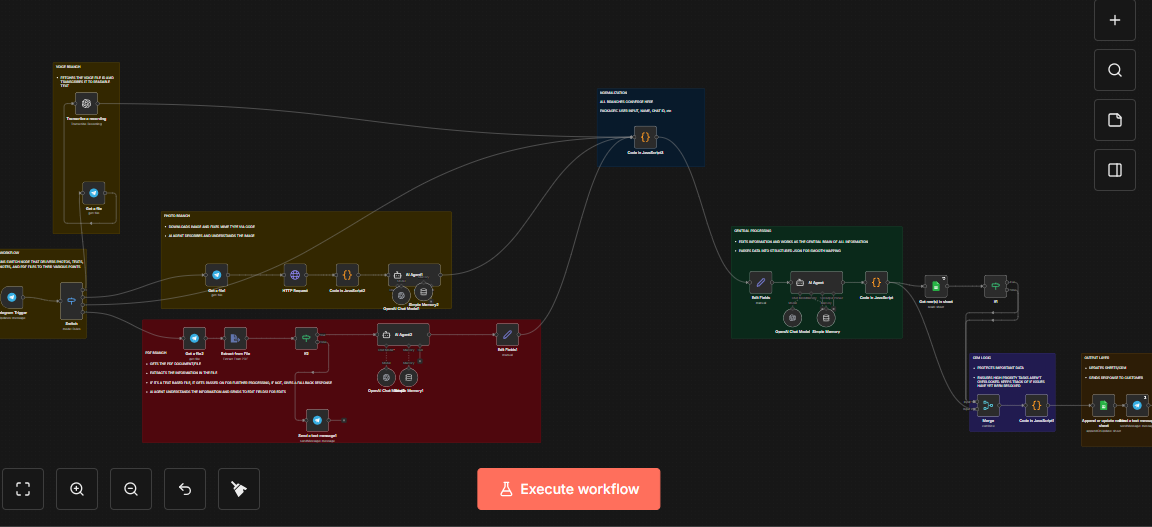
Request Received
Customer submits a message, voice note, image, or document through the support platform.
AI Classification
The language model analyzes the request, extracts intent, determines priority, and generates structured metadata for downstream processing.
Validation Layer
Deterministic JavaScript logic validates required fields, prevents duplicate tickets, and enforces business rules before execution.
CRM Integration
Validated requests are routed to the CRM, assigned automatically, and trigger notifications or human review where required.
Design decisions that made the support system production-ready.
The platform was built as an operational support system rather than a simple AI chatbot. Multimodal intake, AI classification, deterministic validation, priority escalation, case tracking, automated follow-ups, and human review work together to move each request toward resolution.
Multimodal Intake
Text, voice notes, images, and documents enter the same support workflow, giving customers one consistent channel for different types of requests.
AI Classification
The language model identifies intent, summarizes the issue, determines priority, and extracts structured information for the workflow to process.
Deterministic Validation
JavaScript validates AI outputs and required fields before execution, preventing malformed requests and keeping business rules outside the model.
Priority Escalation
High-priority cases are identified automatically and routed for faster operator attention instead of being treated like routine support requests.
Case State Tracking
Each support request can move through a defined lifecycle, making it possible to track active cases, pending actions, follow-ups, and resolution.
Automated Follow-up Engine
Cases that require a later response can trigger follow-up workflows automatically, reducing the chance of unresolved requests being forgotten.
Duplicate Prevention
Workflow logic checks incoming requests before creating new cases, reducing duplicate tickets and unnecessary work for support operators.
Human Escalation
Complex, uncertain, or high-impact cases can be handed to human operators instead of forcing the AI to make a decision outside its confidence or authority.
Resolution-Oriented Workflow
The system is designed to move requests beyond classification toward a resolved state through case tracking, operator intervention, notifications, and follow-up actions.
What this project taught me.
AI should understand, not execute.
Large language models excel at interpreting customer intent, but deterministic workflow logic should always control business actions.
Validation is as important as intelligence.
Reliable automation depends on validating inputs, preventing duplicate requests, and enforcing business rules before downstream execution.
Human oversight increases trust.
Escalating low-confidence or high-priority cases to human operators creates a safer and more dependable support system.
Observability simplifies maintenance.
Building workflows that expose failures, retries, and execution paths makes production systems easier to debug and continuously improve.
Outcome
From customer enquiry to operational workflow. Fully orchestrated.
The platform demonstrates how AI can enhance customer support without replacing operational control. Intelligent request understanding, deterministic validation, and automated workflow orchestration work together to create a production-ready system that scales reliably while keeping humans in the decision loop.